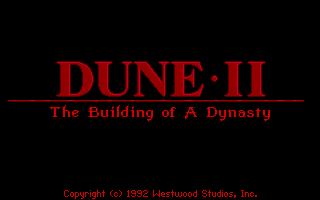
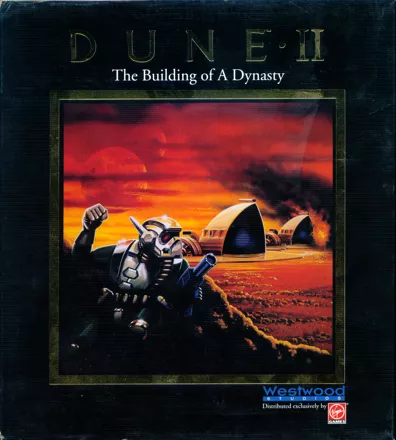
Dune II: The Building of a Dynasty
by Westwood Studios·published by Virgin Games
Reader score
8.0/ 10
190 votes
Where to get it
Community
Trailer
Gallery
33About
The planet Arrakis (also known as Dune for its sandy landscape) is the only place in the known universe where Melange (more commonly known as the Spice) can be found. The Spice is the basis of interstellar travel and thus the standard of the Imperial economy. To increase productivity, The Padishah Emperor has invited three powerful Houses (Harkonnen, Atreides, and Ordos) to compete against one another economically and bring up spice production. Competition among these houses begins peacefully but soon turns ugly as they battle each other with armed troops, advanced weaponry, and spies. The planet itself is also hostile, with dangerous sandworms inhabiting the spice fields.
Dune II is often considered the first mainstream modern real-time strategy game and established many conventions of the genre. Even though set in Frank Herbert's famous Dune universe, the game is only loosely connected to the plot of any of the books or the films based on them. Controlling either of the three Houses, the player must fight a number of battles against the other Houses. In the early levels, the goal is simply to earn a certain number of credits, while in the later missions, all enemies must be destroyed.
The single resource in the game is the Spice, which must be collected by harvesters. The spice is converted to credits in a refinery, which are then spent to construct additional buildings and units. There are two terrain types: buildings can only be constructed on stone, while the Spice is only found on the sand. However, units moving on sand attract the large sandworms of Dune, who are virtually indestructible and can swallow even large units whole. As levels progress, new and more advanced buildings and units are made available, including structures like a radar station, a repair facility, or defense turrets and, for units, various ground troops, light vehicles, and tanks. Each House can construct one unique special unit, and, after building a palace improvement, can unleash a unique palace effect.
After a mission is completed, the player can select the next mission on a map of Dune. This choice determines the layout of the next map to be played but has no effect on the overall campaign.
Ways to play
Modes
Perspective
Mods
Ported as
Remade as
Game details
Business Model
Commercial
Media Type
3.5" Floppy Disk, 5.25" Floppy Disk, CD-ROM
Input Devices Supported/Optional
Keyboard, Mouse
Number of Offline Players
1 Player
Save Game Methods
Manual Save
System requirements
Min. CPU Class Required
Intel 8088 / 8086
Min. OS Class Required
PC/MS-DOS 3.3
Min. RAM Required
640 KB
Min. MSCDEX Required
2.1
Min. CD-ROM Drive Speed Required
1X (150 KB/s)
Video Modes Supported
MCGA, VGA
Sound Devices Supported
Adlib, Adlib Gold, PC Speaker, Roland MT-32 (and LAPC-I), Roland Sound Canvas, Sound Blaster, Sound Blaster Pro, Tandy / PCjr
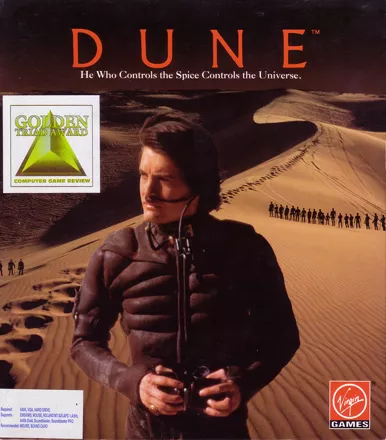
Box art
Also known as
Dune 2 — Informal / budget release media title
Dune II — European floppy disk title
Dune II: Battle for Arrakis — European title
Dune II: Der Kampf um Arrakis — German in-game title
Dune II: The Battle for Arrakis — European in-game title
Reader ratings
Rate this game
Nobody has rated this yet.
Facts
Developer
Publisher
Released
1 December 1992
Series
DunePlatforms
Age ratings
Standing
Top 11% by visits