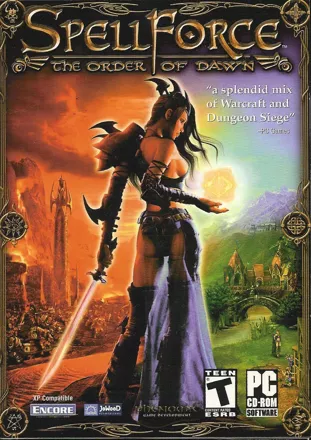
SpellForce: The Order of Dawn
by Phenomic Game Development·published by JoWooD Productions Software
Reader score
7.8/ 10
42 votes
Where to get it
Community
Trailer
Gallery
49About
EO, the world in which the game takes place was torn apart by a ritual called the Convocation. The ritual caused the destruction of the continents and was performed by each of the thirteen most powerful mages (both light and dark) on EO, who collectively were known as The Circle. The Circle ruled EO before its destruction and had slowly expanded their knowledge and power. Their vast knowledge allowed them to extend their lifespan to a point near immortality. Across EO they resurrected rune monuments that could be used to quickly call forth obedient armies to enforce their rule (known as the Rune) and bring peace to all the races of EO. At some point they learned of an ancient text describing a ritual supposedly granting immense power, possible under a certain alignment of planets. Not willing to share this power, wars between the various Circle mages erupted. When the time came each preformed the ritual, but none could tame the elemental forces and the continents shattered. After the event only isolated islands around magical towers remained. The islands were later connected by magical portals that make travel between them possible. At the start of the game the player is resurrected by Rohen, a former mage of The Circle. He is also the one who connected the islands using the portal system in an act to redeem himself and is believed to be the only mage of The Circle to have survived the Convocation. He instructs you to travel to Greyfell, the headquarters of the Order of Dawn. Soon after this you learn that a second Circle mage has survived and embark on a quest to inform Rohen of this fact.
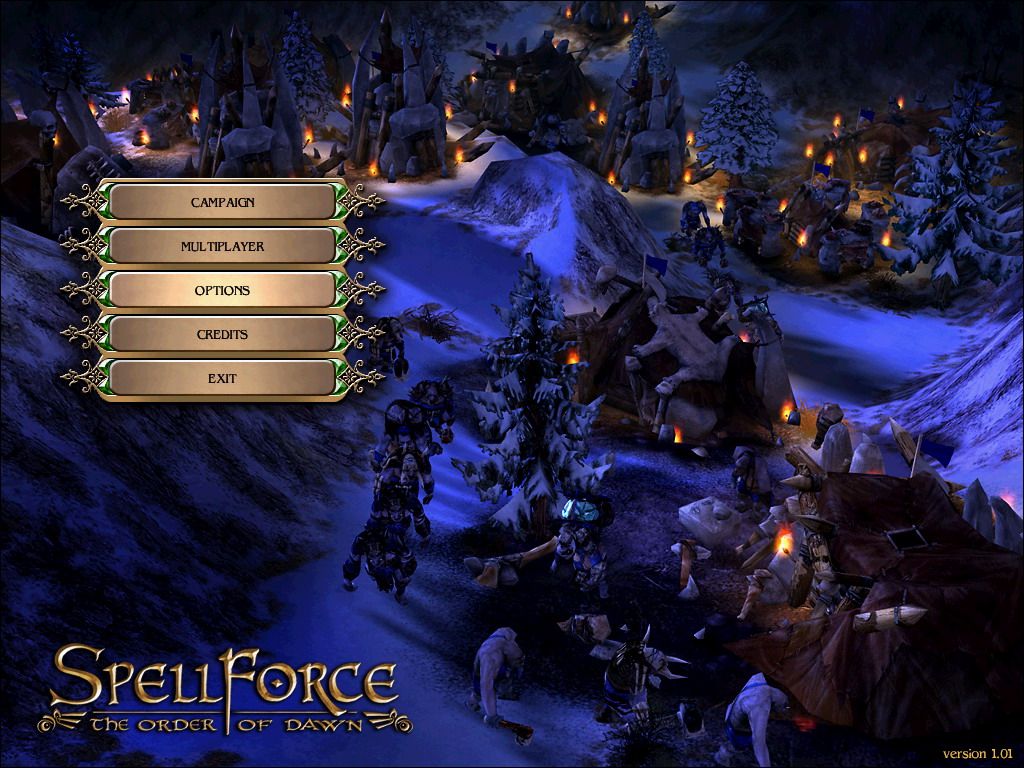
SpellForce is a real-time strategy game with RPG elements, similar to Battle Realms. Unlike that game, SpellForce gives more focus to the hero. In fact, the player can go into third person view (only for the hero) and play it like a hack and slash game. The game features six playable races. The player character is called a rune warrior, an immortal warrior bound to a stone by The Circle to fight their wars. If the avatar dies, he will respawn at the last activated bindstone (stones around the map that can be activated and used for fast travel).
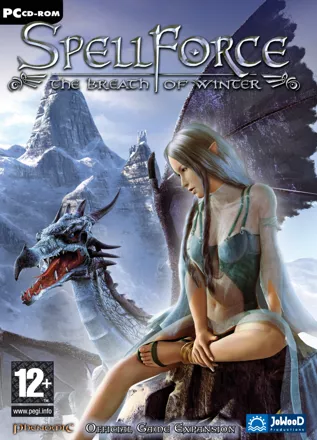
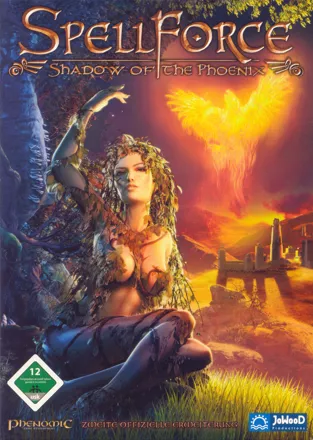
As the game progresses the player will find rune stones of six races (humans, dwarves, elves, orcs, trolls and dark elves) and hero runes. After being inserted into the rune board, they can be trained at their respective monument and help the player in the quest. The player will also find building planes for each of the races. When a monument of a race is switched on worker units can be trained to gather resources and construct buildings. This will eventually allow the player to train fighting units to overcome an enemy base. With the avatar rising in level runes and items of a higher level can be used to kill tougher enemies. The game has a lengthy single player campaign of 20+ maps. It was followed by two expansions called The Breath of Winter and Shadow of the Phoenix.
Ways to play
Modes
Perspective
Editions
Expansions
Included in
Game details
Business Model
Commercial
Supported Systems/Models
x86 (32-bit)
Media Type
CD-ROM, DVD-ROM
Input Devices Supported/Optional
Keyboard, Mouse
Additional Hardware Required
3D Accelerator
Multiplayer Options
Internet, LAN
Number of Offline Players
1 Player
Number of Online Players
2-8 Players
System requirements
Min. CPU Class Required
Intel Pentium III
Min. OS Class Required
Windows 98
Min. RAM Required
256 MB
Min. DirectX Version Required
DirectX 9.0a
Min. Video Memory Required
32 MB
Video Modes Supported
Full screen
Video Resolutions Supported
1024×768
Box art
Also known as
Fantasy — Working title
SpellForce: Zakon Świtu — Polish title
Reader ratings
Rate this game
Nobody has rated this yet.
Facts
Developer
Publisher
Released
26 November 2003
Series
SpellforcePlatforms
Age ratings
Standing
Top 2% by visits