As the PlayStation 5 enters its seventh year on the market, Sony is gradually preparing for the transition to its next home gaming platform, the PlayStation 6. However, while technological progress continues to push hardware capabilities forward, rising production costs and economic pressures could challenge one of the console industry's long-standing advantages: offering an accessible alternative to expensive gaming PCs.
Recent reports suggesting that memory and storage components alone could cost Sony nearly $700 per PS6 have raised concerns that the console's launch price could reach or even exceed $1,000.
Such a price would represent a major departure from the traditional console pricing model, and the latest survey results suggest that many players are not ready to accept that possibility.
Poll reveals a clear price limit for gamers
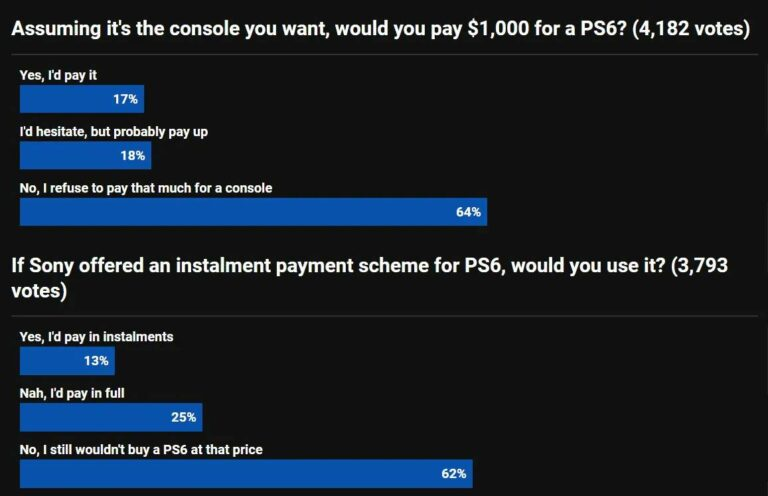
In a poll conducted by Push Square, which attracted more than 4,000 participants, readers were asked whether they would buy a PlayStation 6 priced at $1,000.
The results revealed considerable resistance to the idea, with 64% of respondents saying they would not buy the console at that price.
Only 17% said they would be willing to pay $1,000 without hesitation, while another 18% said they were unsure.
The prospect of paying in installments did little to change the overall picture. When participants were asked whether they would consider buying the console if installment payments were available, 62% still said they would not purchase it at that price.
Although online polls do not necessarily reflect the opinions of the entire gaming community, the results suggest that a four-figure price tag could be a significant obstacle for Sony when launching its next-generation hardware.
Rising hardware costs could reshape the Next console generation
With the PlayStation 5 having already experienced several rounds of price increases in global markets, the possibility of the PlayStation 6 entering a price bracket close to $1,000 in 2027 or 2028 is becoming an increasingly prominent topic of discussion.
Microsoft faces a similar challenge. Its upcoming Project Helix hardware has also been linked to estimates of a potential price as high as $1,800, suggesting that the industry could be heading toward a more expensive generation of gaming devices.
However, neither Sony nor Microsoft has officially confirmed the final retail prices of their next-generation hardware.
With component costs remaining a major concern and players expressing clear limits on what they are willing to spend, the next console transition could prove particularly challenging for both manufacturers.
Another important factor will be cross-generation support. If developers continue releasing major games for current-generation consoles alongside their successors for several years, some players may see less reason to upgrade immediately.
Ultimately, Sony and Microsoft will need to balance hardware performance, production costs, and consumer expectations. The question is no longer simply how powerful the next consoles will be, but how much players will be willing to pay for that additional power.



Discussion(0)