

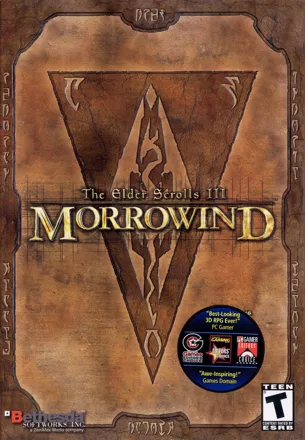
The Elder Scrolls III: Morrowind
by Alcachofa Soft·published by Crimson Cow, The Adventure Company
Reader score
8.3/ 10
311 votes
Where to get it
Trailer
Gallery
51Screenshots
Key art
About
Freed by the decree of Uriel Septim VII, the Emperor of Tamriel, a lone prisoner is transported to the province of Morrowind. It seems that the strange dreams this prisoner has been having lately may have a connection to equally strange events occurring there. The protagonist is given a simple assignment: join the Blades, a secret organization whose goal is to protect the safety of the Emperor. This leads to a discovery of an ancient prophecy and an evil scheme concocted by a powerful deity whom the protagonist alone is able to stop.
Conceived in the tradition of the Elder Scrolls series, Morrowind is a fantasy role-playing game with a vast world open for exploration. After being released from a prison ship at the shores of the island Vvardenfell, the protagonist may do more or less what he or she wants: follow the main quest and solve the mystery of an ancient prophecy, join any of roughly a dozen guilds and rise in their hierarchy by performing duties, or simply explore the gigantic island with its stylistically diverse cities, hundreds of dungeons and tombs, ancient ruins and mighty fortresses.
Morrowind uses a two-stage skill system. The hero’s primary stats (strength etc.) increase with each level gained, while secondary abilities improve by use – for example, the more often the character jumps, the more proficient he or she becomes in the Acrobatics skill, etc. The action-oriented fights are simple exchanges of strikes or spells, until one combatant dies. The enemy's hit points and condition were not originally shown; however, at the request of customers a health bar was added for enemies as part of the first upgrade patch.
The protagonist's race and gender, but also his or her reputation influence the reactions of NPCs. If a character’s sympathy for the hero is low (rated on a scale from 1 to 100), he might refuse to answer questions; if it is high, the player will get more detailed information and better bargains in shops. Most quests involving other persons can be solved by persuasion, pick-pocketing, or simply by force.
The game's NDL 3D game engine is powerful in drawing wide, detailed outdoor landscapes as well as complex indoor environments. Transitions are not fluent; houses and dungeons must be loaded upon entering.
Ways to play
Modes
Perspective
Expanded into

Languages
1 languages, with audio, subtitles and interface
| Language | audio | subtitles | interface |
|---|---|---|---|
| English | — |
Game details
Business Model
Commercial
Supported Systems/Models
x86 (32-bit)
Media Type
CD-ROM, DVD-ROM
Sound Capabilities
DirectSound3D
Input Devices Supported/Optional
Keyboard, Mouse
Additional Hardware Required
3D Accelerator
Number of Offline Players
1 Player
System requirements
Min. CPU Class Required
Intel Pentium III
Min. OS Class Required
Windows 98
Min. RAM Required
128 MB
Min. DirectX Version Required
DirectX 8.1
Min. CD-ROM Drive Speed Required
8X (1.2 MB/s)
Min. Video Memory Required
32 MB
Video Resolutions Supported
640×480, 800×600, 1024×768, 1152×864, 1280×960, 1600×1200
Box art
Also known as
Murder in the Abbey — Other
Reader ratings
Rate this game
Nobody has rated this yet.
Facts
Developer
Publisher
Released
1 May 2002
Platforms
Age ratings
Standing
Top 38% by want to play
Tags
Games like this





You might also like




Game and studio data from IGDB, with release information from Steam, PlayStation, Xbox and Nintendo.