
Alien Legacy
by Ybarra Productions·published by Sierra On-Line
Reader score
7.7/ 10
28 votes
Where to get it
Community
Trailer
Gallery
32About
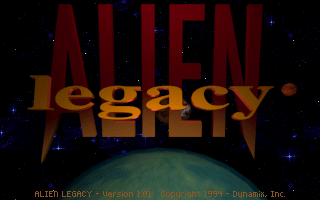
After an alien attack in 2043, great technological leaps were made and space travel was significantly improved upon. In 2119, fearing extinction, Earth built gigantic seedships designed as "arks" to propel people and the sum of human knowledge across the stars. One of these seedships, the UNS Calypso, is sent to Beta Caeli star system which is the farthest colony attempted yet. In 2135, a second seedship, the UNS Tantalus, is dispatched to the same destination in order to better the chances of human survival. The Tantalus is equipped with a more advanced fusion engine and thus will reach Beta Caeli some 21 years ahead of the Calypso. The player takes the role of the Calypso's captain. There is no sign of the Tantalus. All you have are some 5000 colonists, past radio transmissions and a few key advisers to help you colonize this new unfamiliar solar system.
The game has three distinctive parts: global strategy, colony management and searching planets. The latter is always the first part before colonizing a planet: Every planet is divided into sectors which can be chosen on a world map. Then the game switches to a 3D view (which can be switched to a 2D view) in which the player explores the sectors in search of different symbols - clicking on them results in certain benefits. Examples are ore and energy, the two main resources in Alien Legacy, new life forms or traces of a lost civilization which give hints about the awful events of the past. With the correct technology the player can scan both the world map and the sectors to shorten the search - but this costs fuel.
The strategy mostly involves sending out ships to new planets to colonize and researching. Research is powered by "research points" in different categories, e.g. biology or math, which are gathered when searching sectors. By using those points the player gets different technologies of various use like more productive mines or a better range for space ships. Lastly the colonies are viewed from a top-down perspective. Here the player constructs up to 16 buildings to produce resources or space ships. Those buildings have to be maintained or can be upgraded/replaced with the newest research achievements. Every colony also needs a steady number of people, material and robots or it can't produce.
The game is played in real-time; the rounds (two rounds represent a month) elapse if the player is active or not. But time can be slowed down to ease the stress. After about 2000 rounds the peaceful colonizing is over, and the player has to fight a war against an unknown foe..
Ways to play
Modes
Perspective
Languages
2 languages, with audio, subtitles and interface
| Language | audio | subtitles | interface |
|---|---|---|---|
| English | |||
| German | — |
Game details
Business Model
Commercial
Media Type
3.5" Floppy Disk, CD-ROM
Input Devices Supported/Optional
Keyboard, Mouse
Number of Offline Players
1 Player
System requirements
Min. CPU Class Required
Intel i386 SX
Min. OS Class Required
PC/MS-DOS 5.0
Min. RAM Required
4 MB
Min. CD-ROM Drive Speed Required
1X (150 KB/s)
Video Modes Supported
VGA
Sound Devices Supported
Adlib, Ensoniq Soundscape, General MIDI, Gravis Ultrasound / ACE, Pro Audio Spectrum, Pro Audio Spectrum 16, Sound Blaster, Sound Blaster 16, Sound Blaster Pro
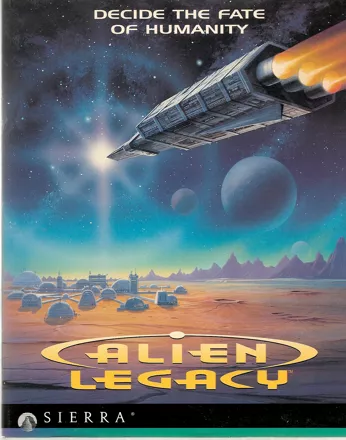
Box art
Also known as
Alien Legacy: Decide the Fate of Humanity — Tag-lined title
Reader ratings
Rate this game
Nobody has rated this yet.
Facts
Developer
Publisher
Released
1994
Platforms
Age ratings
Standing
Top 82% by visits
Tags
Games like this



You might also like




Game and studio data from IGDB, with release information from Steam, PlayStation, Xbox and Nintendo.