
There's a specific kind of dread that has nothing to do with something chasing you. It's the feeling of walking into a room that shouldn't exist — that can't exist — and slowly realizing the architecture isn't made of stone or concrete but of things that were once alive. Necrophosis: Full Consciousness operates almost entirely in that register, and for long stretches, it does so with uncommon conviction.
Developed by Dragonis Games, a Greek studio that previously explored Lovecraftian unease with The Shore, Necrophosis is a first-person horror-adventure set billions of years after the death of the universe. What remains is not ruin in any conventional sense — it's something closer to a cosmic sediment: layers of dead civilizations, petrified gods, corrupted memory, and the strange rituals that have continued even after everything that gave them meaning has long since collapsed. It's a premise that could easily tip into self-parody, but the game commits to it with enough sincerity and visual intelligence that the world holds.
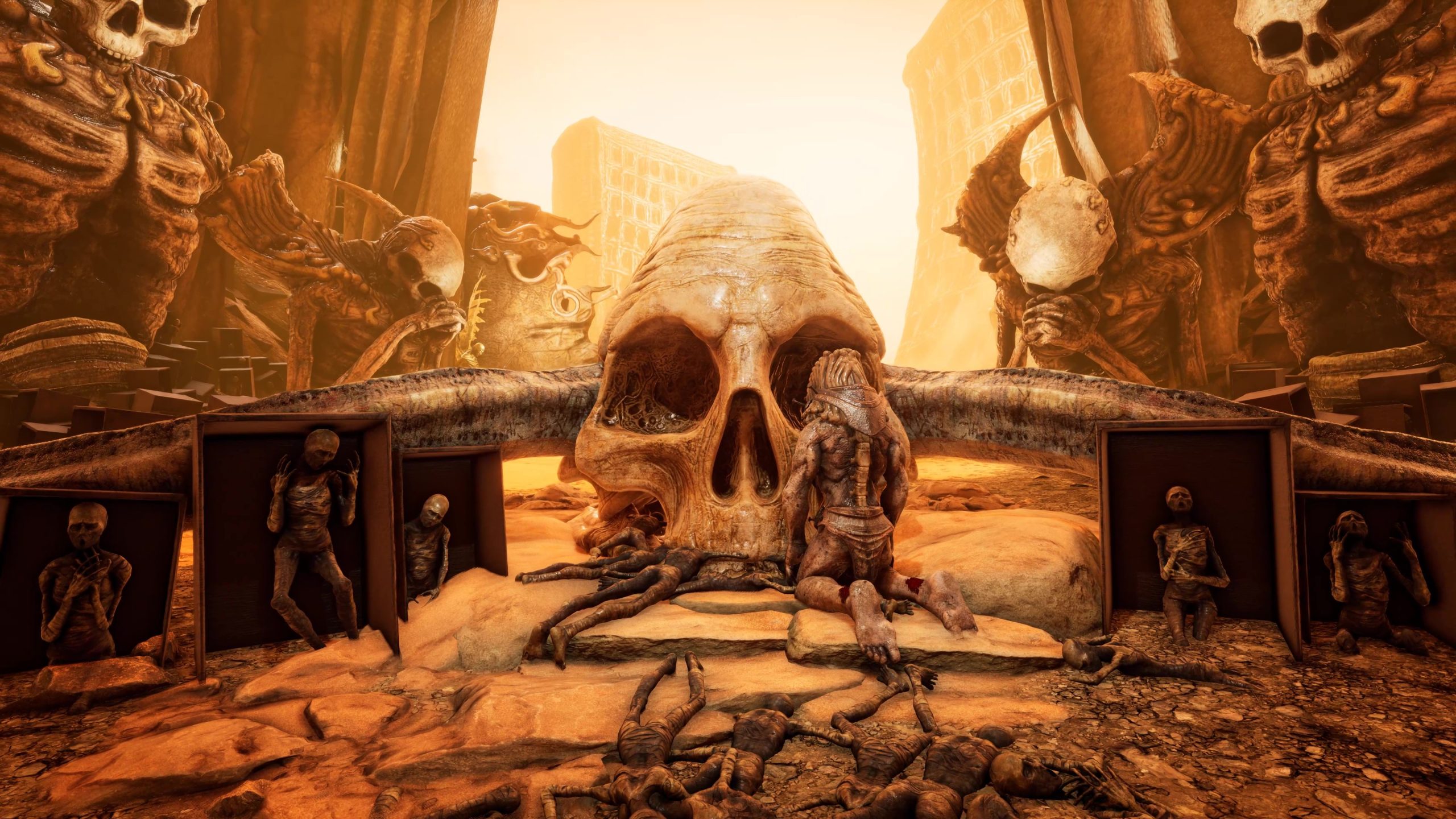
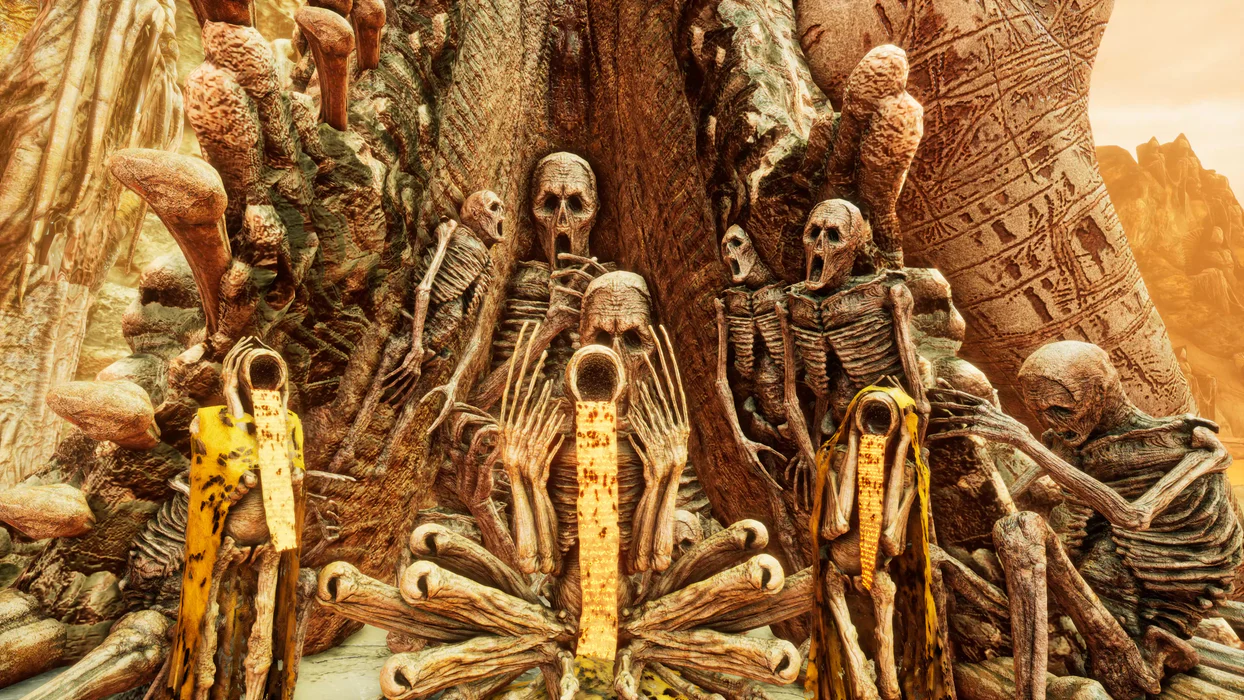
Before anything else, this needs to be said plainly: Necrophosis is one of the most visually distinctive horror games to come out in years. The influences are legible — H.R. Giger's biomechanical claustrophobia, Zdzisław Beksiński's landscapes of spiritual catastrophe — and the game makes no effort to conceal them. But citing an influence is not the same as being absorbed by it. Dragonis has internalized these aesthetics and built something that stands as its own specific vision: temples constructed from compacted bodies, monuments that seem to exist simultaneously as architecture, machinery, and corpse, doors formed from arrangements of flesh and bone that somehow still function.
Unreal Engine 5 gives the environments genuine scale and texture, but the technology is in service of the art rather than the other way around. Giant skeletal forms emerge from sand. Faces press outward from blocks of organic matter. A living figure reaches into its own torso and withdraws something for you to carry forward. It is the kind of world where the boundary between structure and organism has not blurred but simply ceased to exist, and every new area carries the promise of something stranger than the last.
This is horror that operates through sustained wrongness rather than sudden shock. The game is not especially interested in jump scares or creature chases. Its unsettling quality comes from observation — from spending time in spaces that communicate a history too vast and too damaged to fully reconstruct, and from being asked to interact directly with the remains of whatever this universe once was.
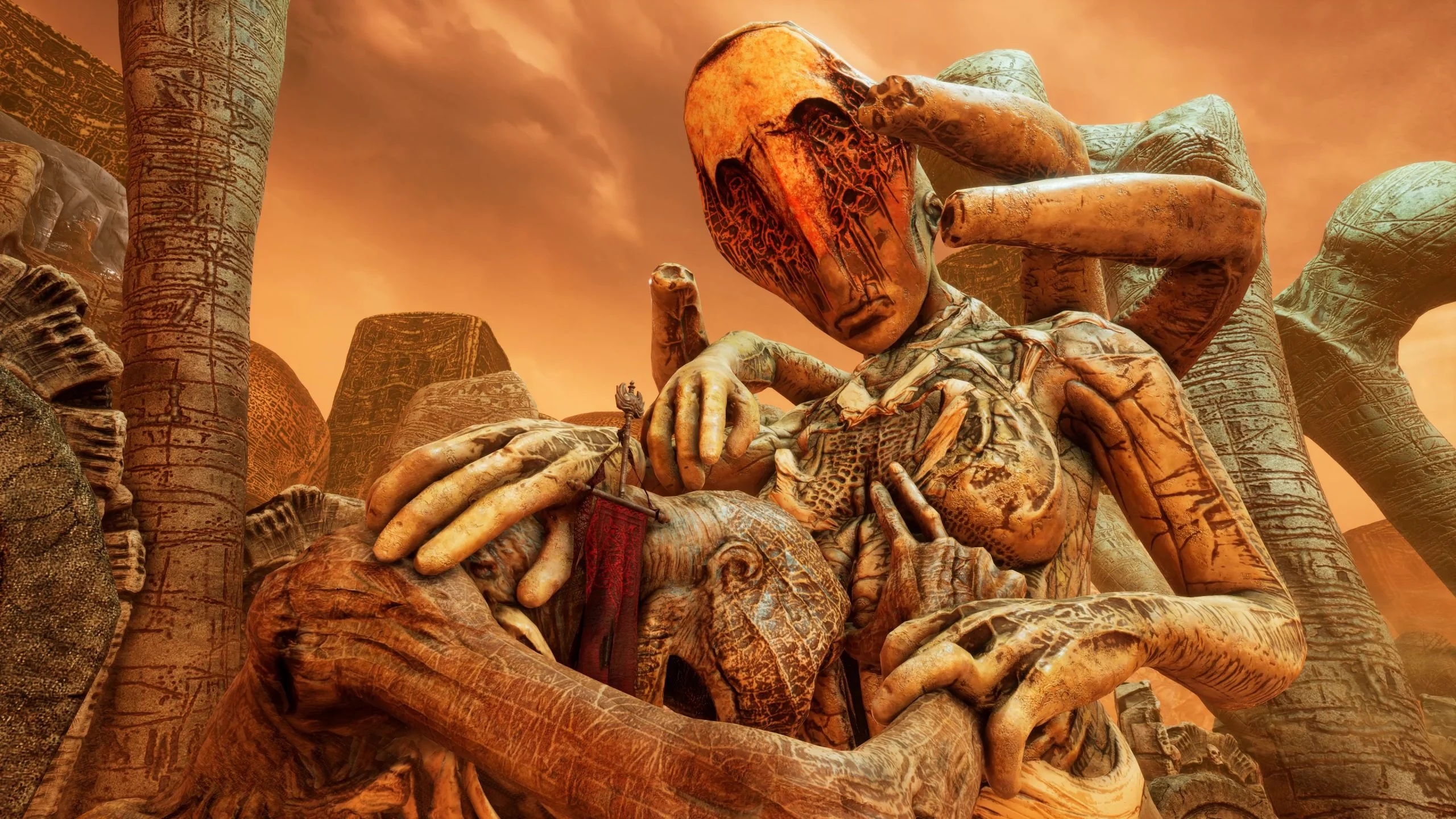
Necrophosis frames its progression as puzzle-adventure gameplay, and the core loop involves finding objects — biological, ritualistic, or structural — and placing them correctly within the game's grotesque environments. Relics are extracted from bodies. Organic fragments are gathered and inserted elsewhere. Passages open through acts that feel more like dark ceremony than mechanical interaction.
In its early hours, this approach is quietly brilliant. Restoring a dead brain within a preserved organic structure, situating bone crowns on the correct corpses, triggering passageways through acts the game refuses to explain in clinical terms — these moments succeed because the world around them earns the strangeness. One sequence involves a maggot-filled corpse whose movement patterns encode the solution. The puzzle logic is basic. The experience of working through it is not. Necrophosis consistently wraps simple actions in enough biological and conceptual texture that the distinction between "game mechanic" and "ritual act" becomes meaningfully blurred.
The problem is that this gap — between the simplicity of the mechanics and the complexity of the world — eventually becomes a source of frustration rather than atmosphere. By the midpoint, the structure has become recognizable: explore an area, find the unusual object this area is offering, locate the biological or architectural receiver it belongs to. The game hints at a more demanding puzzle system beneath the surface, something proportional to the imaginative reach of its design. That system never materializes. What could have been a growing intellectual engagement with the world becomes, after a few hours, largely a spatial memory exercise.
To the game's credit, the context around each action rarely feels throwaway. Necrophosis almost never places a conventional object in a conventional location for a conventional purpose. Even when the underlying task is thin, the ritualistic framing keeps it connected to the setting in ways that prevent the loop from feeling entirely mechanical. But there's a ceiling on how much atmosphere can compensate for repetition, and Necrophosis does eventually brush against it.
The story is told the way the puzzles are solved — obliquely, through fragments, with the expectation that the player will do significant interpretive work. Ancient figures speak in incomplete sentences. Poetic text crawls across surfaces. Locations accumulate meaning through layered imagery rather than explanation. The game is not trying to tell you what happened to this universe. It is trying to give you the sensation of being inside its remains.
When this works, it works well. Moving through impossible monuments and assembling a picture of a cosmic tragedy from scattered lore fragments can be genuinely absorbing. The ambiguity feels earned — like standing inside an ancient ruin with no guidebook, finding the weight of the place through proximity rather than information.
When it doesn't work, the game mistakes withholding for profundity. Certain stretches of narration return repeatedly to the same conceptual orbit — death as continuation, consciousness as residue, decay as meaning — without adding traction to either the ideas or the emotional experience. Mystery is a legitimate storytelling instrument, but it requires that its symbols accumulate into something. Not all of Necrophosis' symbols do. There are moments where the abstraction begins to feel like a buffer against commitment rather than a considered artistic choice.
The full experience lands somewhere in the four-to-five hour range, which is the right length for what the game is doing. A longer runtime would expose the mechanical thinness more severely. Even at this length, certain sections begin to feel like transit rather than experience — moving objects between grotesque locations that aren't generating new ideas.
That brevity also means the game doesn't have room to develop into the more complex experience it sometimes suggests it wants to be. The puzzle design stays flat. The narrative doesn't cohere into a sharper emotional resolution. Necrophosis maintains the same register from beginning to end — hypnotic, occasionally passive, consistently strange.
Necrophosis: Full Consciousness is a flawed game made by people with a genuinely distinctive visual imagination. The puzzle design is too shallow for the world it inhabits. The narrative's commitment to abstraction occasionally tips from evocative into evasive. And there are stretches where the experience asks less of the player than it should.
None of that is enough to dismiss what Dragonis Games has built here. The imagery — the skeletal monuments, the body-doors, the maggots, the organs repurposed as mechanisms — stays in the mind the way very few horror games manage. There is a category of horror experience that frightens you in the moment, and another that settles quietly into your imagination and refuses to leave. Necrophosis belongs entirely to the second. As a puzzle-adventure, it under-delivers. As a descent into a dead universe that somehow still breathes, it's one of the harder things to forget.

Discussion(0)