

On October 18, 1958, visitors to Brookhaven National Laboratory in New York lined up to play Tennis for Two, an electronic tennis game that would eventually earn its place as one of the earliest and most influential creations in video game history.
Developed by physicist William Higinbotham, who headed Brookhaven's Instrumentation Division, the game made its public debut during the laboratory's annual visitors' day. What began as a simple attempt to make a science exhibition more entertaining would go on to become an important milestone in the history of interactive entertainment.
A video game born inside a laboratory
Higinbotham believed that traditional scientific exhibitions were often too static and uninteresting for visitors. He wanted to create something interactive that could demonstrate how science and technology could also be entertaining.
The idea emerged while he was reading the instruction manual for a Donner Model 30 analog computer. The manual described how the machine could simulate the trajectory of a bouncing ball, taking gravity and wind resistance into account.
Higinbotham realized that the same technology could be used to create a simple tennis game.
He reportedly spent around two hours sketching the initial design. Brookhaven technician Robert V. Dvorak then assembled the system in approximately three weeks, turning the concept into a functioning interactive game.
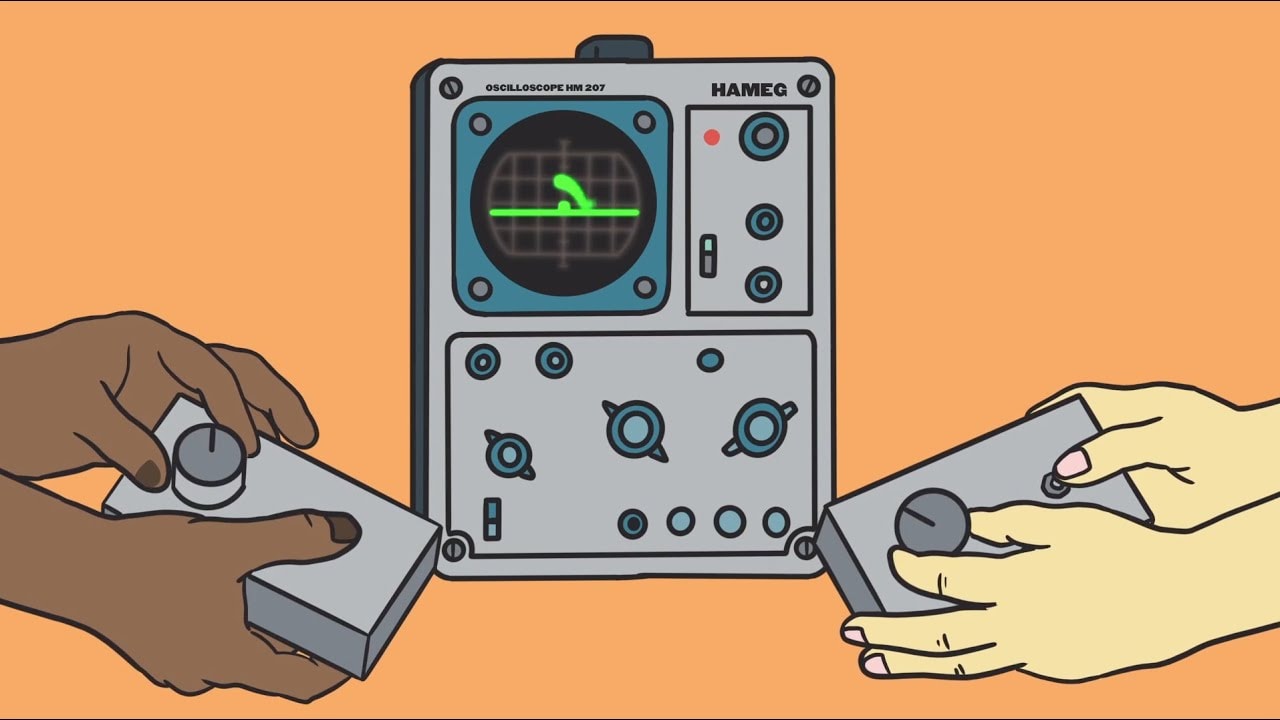
Unlike modern video games, Tennis for Two did not use a television or conventional computer monitor. Instead, it displayed the action on a five-inch oscilloscope screen, showing a two-dimensional tennis court from a side perspective.
Each player held a separate controller equipped with a button to hit the ball and a rotating dial to adjust the angle of the shot.
Despite its simplicity, the game proved remarkably popular. Hundreds of visitors waited in line to experience something that was almost unimaginable for most people at the time.
From a scientific demonstration to gaming history
The success of Tennis for Two encouraged Brookhaven to present an improved version in 1959.
The updated game featured a larger display and additional options that allowed players to experience different gravitational conditions, including simulations of tennis played on the Moon and Jupiter.
However, the project was never intended to become a commercial product.
After its exhibitions, the game was dismantled, and its original hardware was not preserved as a complete system.
Higinbotham, who had previously worked on the Manhattan Project and later became an advocate for nuclear nonproliferation, never patented Tennis for Two or earned money from his invention.
For years, the game remained relatively unknown outside scientific circles.
That changed in 1982 when Creative Computing magazine published an article suggesting that Tennis for Two might have been the first video game ever created.
Was Tennis for Two really the first video game?
Whether Tennis for Two deserves the title of the world's first video game remains a subject of historical debate.
Earlier electronic gaming devices already existed, including the Cathode-Ray Tube Amusement Device from the 1940s and the OXO computer game developed in 1952.
There is also a technical distinction: the oscilloscope used by Tennis for Two did not generate a conventional raster-based video signal.
Nevertheless, Brookhaven National Laboratory emphasizes that Tennis for Two was among the earliest electronic games designed specifically for entertainment rather than academic research or demonstrations of computing technology.
The laboratory later reconstructed the game using Higinbotham's original technical drawings, preserving an important piece of gaming history.
Sixty-eight years later, Tennis for Two remains a reminder that the foundations of modern gaming were laid long before home consoles, gaming PCs, or the internet existed. Sometimes, all it took was a physicist, an analog computer, and the simple idea of making science fun.

Discussion(0)