Google's latest AI model, Gemini 4, has successfully completed one of gaming's most complex titles: Minecraft.
Four Gemini 4 Argon agents defeated Minecraft's final boss, the Ender Dragon, without any human intervention. The agents operated independently while continuously exchanging advice, warnings, and information about their mistakes, according to a new research paper published by Google researchers.
The experiment demonstrates that general-purpose AI models using an agent-based approach can now complete complex games, something that previously required specially developed AI software.
To complete Minecraft, the researchers placed four AI agents in an isolated, randomly generated Minecraft survival world with a single objective: defeat the Ender Dragon.
The agents were not assigned specific roles, strategies, or tools developed specifically for the game. Each agent controlled one player using the open-source Mineflayer library, coordinating with teammates through in-game chat and shared memory.
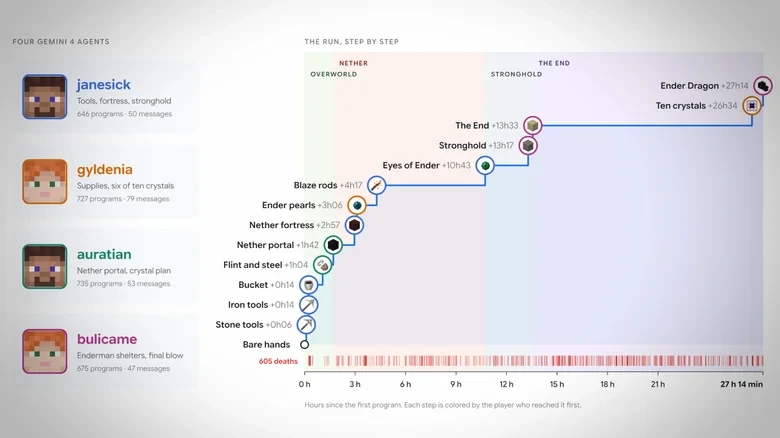
During gameplay, the agents quickly decided to divide responsibilities among themselves.
They warned one another about dangers, exchanged advice and instructions, shared coordinates, and even recovered items from teammates who had been eliminated.
Each agent gradually took on a specific role. For example, janesick focused on crafting tools, gyldenia gathered food and supplies, auratian activated an important portal, while bulicame helped build shelters and ultimately delivered the final blow.
The entire process took 27.23 hours, with the largest portion of that time spent fighting the Ender Dragon.
"The four agents wrote and ran 2,783 programs, exchanged 229 messages, and died 605 times along the way," the researchers reported.
A fifth agent, called The Observer, monitored the session as an independent witness to verify that no cheating occurred. It also published live reports and summaries of the results.
The agents processed 1.35 billion input tokens, while the total session cost was estimated at $810 under Gemini's publicly listed introductory pricing, or $1,620 at standard rates.


Discussion(0)