

Furthermore, they claim that with this technology, it will be possible to achieve a level of graphics and visual effects that until now were only possible within Hollywood productions.
Everyone knows what kind of reactions this announcement caused. The most positive part of the whole story is that it has once again shown that gamers certainly have a good sense of humor. However, the point of this text is not to catch the "hate-train," but an attempt at a more objective look at the entire situation and an attempt to point out the good things that this technology will bring with it.
What exactly is DLSS 5?
To understand what exactly DLSS 5 is now, we must understand what it was before that. In its early stages (DLSS 1 & 2), DLSS presented itself as a technology aimed at improving game performance. This was done in a way that the game renders at a lower resolution – 1080p, and then the AI "stretches" it to a higher one – 4k. With DLSS 3 & 4, a step forward was made, and so we came to frame generation. In short, the AI takes two successive frames and analyzes the direction of movement of every object (not just the camera, but also particles, shadows, UI); in this way, a completely new frame is generated between the two frames.
DLSS 5 introduces a completely new concept called neural shading and moves away from a deterministic approach in favor of probability. Specifically, the old approach implied that if we want to see a reflection on something, the GPU must trace a light ray, calculate the angle of incidence, the surface texture, and where that ray will end up. It sounds like a lot of math, which it essentially is, and thus becomes quite expensive for the hardware.
Neural shading, on the other hand, involves introducing probability, so the GPU renders a "sketch" of the scene (low-res, basic shadows). That sketch is sent to a neural shader that doesn't calculate light, but predicts it. Additionally, the AI actively performs semantic segmentation, which involves identifying what is in the image, resulting in masking the scene in a way that it marks something as steel, something as leaves, something as skin, etc.
Nvidia actually wanted you to hate it!
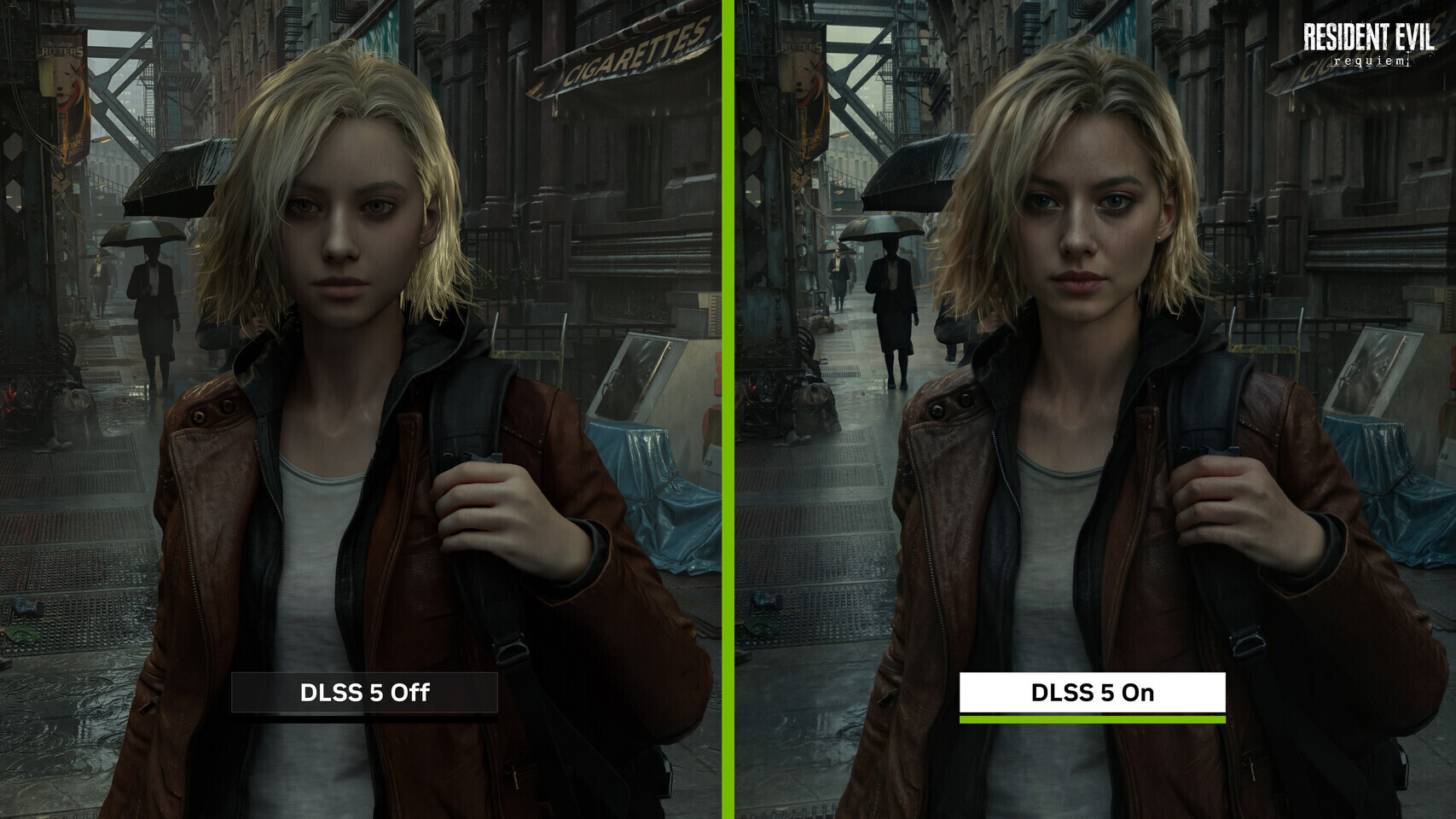
The first showcase of the new version of DLSS was presented through Grace from Resident Evil 9: Requiem and she, as is already clear to everyone, looks terrible. Her face looks different and leans more toward the face of some model walking down the street, rather than a young, frightened woman preparing for the already well-known adventure. I personally believe that the skilled people from Nvidia did this on purpose to trigger negative reactions. Negative publicity is still publicity, and they have completely succeeded, because the entire internet is buzzing about it right now.
However, let’s just look at the other protagonist of RE9, our very dear Leon Kennedy, who, if you ask me at least, we must all agree looks undoubtedly significantly better. Unlike Grace, he doesn't lose any visual identity; he is still entirely himself. To be precise, the changes come down to how parts of his hair and face are lit, more emphasized facial hair on his chin, and slightly better-defined facial features.
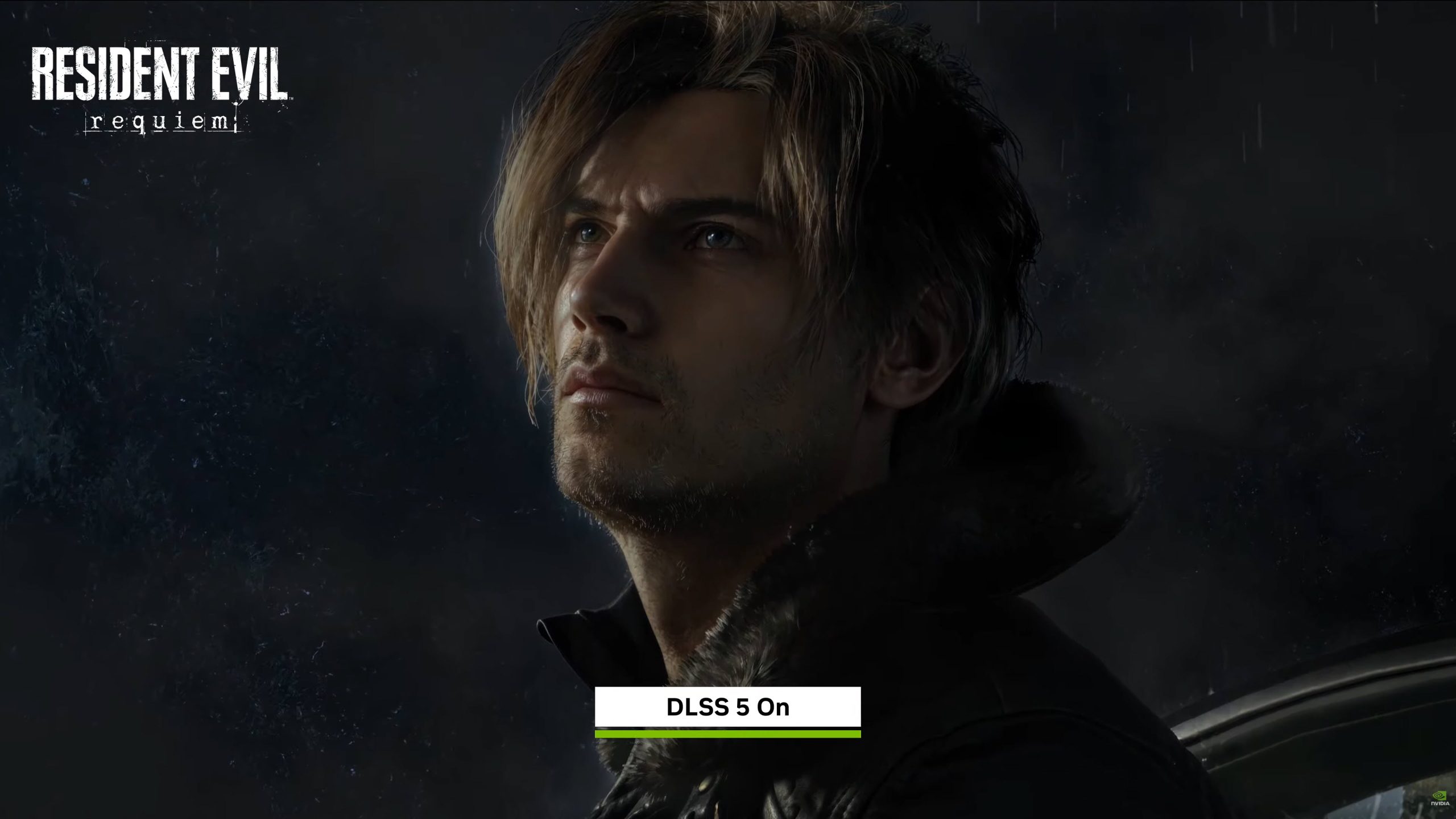
It is necessary to immediately address the thing all critics agreed on, which is that this technology changes facial geometry, which is absolutely wrong. We must take two very important things into account: first, that we had the chance to see mostly static scenes without much action, and the second, much more important one – the change in facial geometry is an optical illusion caused by light, and it is present in real life as well. I know it sounds strange, but you can watch this video and see for yourself how your face could "change appearance" depending on the position of the light source.
So what's going on with those faces?
We need to linger a bit longer on character faces, which have undoubtedly sparked the most controversy. First of all, it's clear that in-game graphics have reached a point where we have photorealistic environments—just look at the water in the 10-year-old The Witcher 3, it looks great, or the environments in RDR2, which are still beautiful. But faces, well, that's a different story. Bringing faces to a level of real-time photorealism is practically one of the most "expensive" problems in computer graphics. The way skin reacts to light is not simple to replicate at all without making the character look lifeless or like a wax figure.
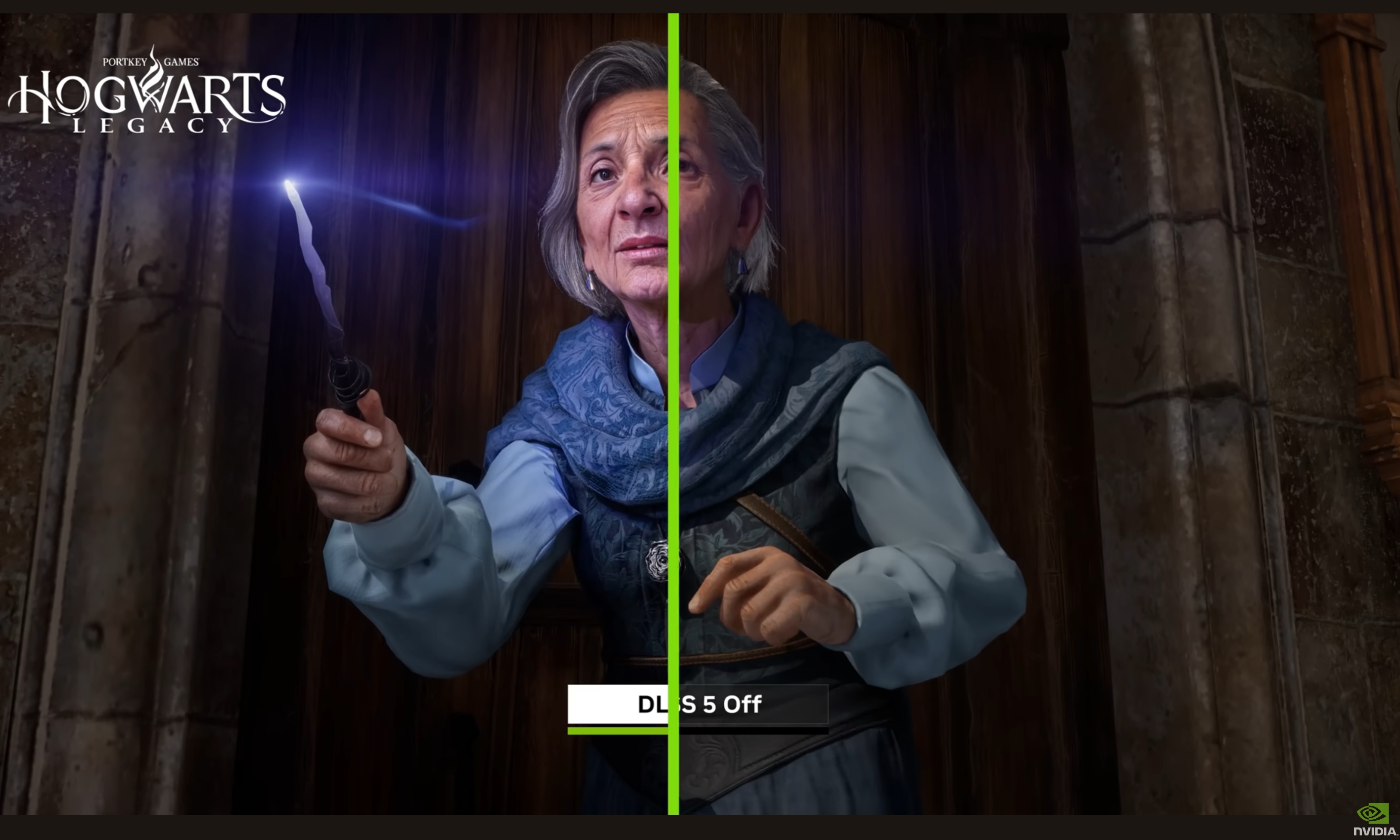
Let’s stick with Grace's face for a moment longer, but this time using a different image from the website where Nvidia provided some flawed explanations. However, what is definitely noticeable in this image is that she no longer looks like an AI-generated ad, but like a living person, and the model fully retains the original vision. Of course, I’m not here to hype something to the moon and sing nothing but praises, but to take a realistic look at the situation. Thus, we have to admit that not every game presented looked good. The application of DLSS to Hogwarts Legacy is, to put it mildly, strange. For me personally, the original style is completely ruined; the characters look too much like "AI slop." Something similar can be said for Starfield, which has rather poor face models; with DLSS, they definitely become more detailed, but not in a way that aligns with the style.
So, the problem that arises is the destruction of artistic intent.
Total control
Let’s get straight to the point—with what we know now, the answer is no, DLSS 5 will not destroy the developers' artistic intent. It should be clear to all of us that everything we read on the internet these days is based on a very small amount of information, but what has been confirmed by Nvidia is that DLSS 5 will come in the form of many independent tools, one of which will be masking. Masking is a form of control that involves giving the developer the ability to choose specific parts of the model where they want—or don't want—to apply DLSS. Likewise, if we set aside the obvious choice of not using the technology at all, the developer will be able to fully control the intensity of individual elements that make up DLSS 5. Therefore, the developer's control won't just come down to toggling it on and off, but to adjusting the intensity of specific parts—contrast, saturation, gamma, etc.

Discussion(1)