Best Discord alternatives in 2026: privacy-focused chat apps for gamers
“The search for Discord alternatives is less about replacing one app with another and more about redefining how digital communities organize themselves.”
As mandatory age-verification requirements loom over Discord in 2026, a noticeable shift is underway across gaming and online communities. What began as scattered complaints about privacy and platform governance has evolved into a broader migration discussion: where should players, modders, and online communities go if they no longer feel comfortable on Discord?
For more than a decade, Discord has functioned as the de facto infrastructure of gaming culture — a hybrid of voice chat, forums, and community hubs. Yet policy changes tied to identity verification, data handling, and platform centralization are pushing some users to reassess their reliance on a single corporate-controlled communication ecosystem. The result is not a mass exodus — at least not yet — but a measurable surge in interest around alternative platforms that promise stronger privacy controls, decentralization, or simply fewer restrictions.
Search data, forum discussions, and developer activity all suggest the same pattern: gamers are exploring backup options. From open-source networks to long-standing voice-chat veterans, a diverse ecosystem of tools is positioning itself as the “next Discord” — though none fully replicate its reach.
This article examines the most credible alternatives in 2026, their technical trade-offs, and why privacy concerns are becoming a central factor in how online communities choose where to gather.
Why Discord Is facing scrutiny
Discord’s growth has been meteoric. By the mid-2020s, the platform hosted hundreds of millions of registered users and had become essential for multiplayer coordination, esports teams, modding communities, and indie game development. Its convenience — free servers, integrated voice and video, bots, and persistent chat — made it difficult for competitors to match.
But scale brings pressure. Regulatory requirements in several regions are pushing platforms to introduce stronger age-verification and moderation systems. For privacy-focused users, this raises familiar questions:
How much personal data is being collected?
Who has access to it?
Can communities retain autonomy?
Even for users who are not strictly privacy activists, the idea of mandatory identity checks has sparked discomfort. In gaming communities that value pseudonymity and informal collaboration, the notion of linking accounts to real-world identification feels like a fundamental shift in internet culture.
That sentiment has translated into rising search queries such as “Discord alternatives,” “private gaming chat,” and “self-hosted voice servers.” While most communities remain on Discord for now, many are testing contingency plans.
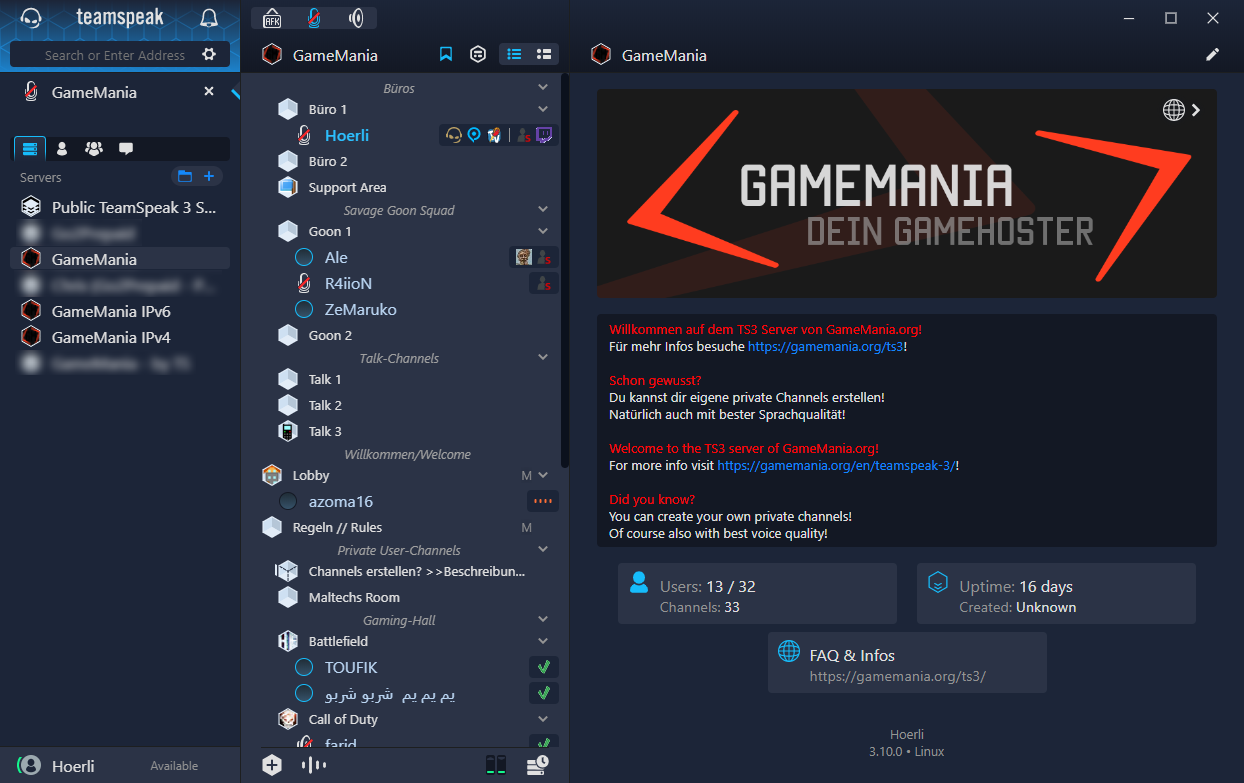
Discord alternatives in 2026: Mumble and TeamSpeak
Among the oldest competitors, Mumble is experiencing renewed attention. First released in 2005, Mumble built its reputation on extremely low latency and high-quality audio — features still prized in competitive gaming. Unlike modern cloud-first platforms, Mumble can be self-hosted, meaning communities can run their own servers and control their data directly.
This model appeals to privacy-conscious users and esports teams alike. Self-hosting eliminates reliance on centralized infrastructure and allows administrators to configure encryption, access control, and storage policies. The trade-off is usability: Mumble’s interface remains utilitarian, and onboarding can feel dated compared to Discord’s polished experience.
Still, for players who prioritize performance and control over aesthetics, Mumble remains one of the most technically robust options available.
Similarly, TeamSpeak continues to maintain a dedicated user base. TeamSpeak 5, currently in extended beta, introduced a more modern interface and improved file sharing, but its core philosophy remains unchanged: private servers first, centralized services second.
TeamSpeak’s long-standing reputation in competitive gaming and modding communities gives it credibility as a fallback platform. Hosting costs for small groups remain relatively low, often just a few euros per month, making it an accessible solution for guilds or teams that want independence from major tech platforms.
Decentralized networks gain momentum: Matrix and Nextcloud
While legacy voice-chat tools focus on performance and control, a newer generation of platforms is emphasizing decentralization and open standards.
Matrix has emerged as one of the most discussed alternatives in privacy-focused circles. Rather than a single platform, Matrix is a decentralized communication protocol that allows independent servers to interconnect. Users can host their own homeservers or join public ones, maintaining control over data while still interacting across the wider network.
Clients such as Element provide Discord-like interfaces with text channels, voice chat, and file sharing. Because Matrix is open source and federated, it appeals to communities that want long-term independence from any single company. However, decentralization introduces complexity. Setting up and maintaining servers requires technical knowledge, and performance can vary depending on hosting quality.
Another option gaining traction is Nextcloud Talk, part of the broader Nextcloud ecosystem. Designed primarily for collaborative work environments, it integrates chat, video calls, and file storage into a single self-hosted platform. For gaming communities that already manage shared assets — mods, builds, or creative projects — this integration can be a major advantage.
Nextcloud Talk is less optimized for large public communities than Discord, but for private groups seeking autonomy, it represents a viable alternative.
Simplicity and integration: Steam chat
For gamers who prefer convenience over technical setup, Steam Chat remains a practical option. Built directly into Valve’s Steam platform, it offers group voice channels, messaging, and video calls without requiring additional accounts or servers.
Steam Chat lacks some advanced moderation tools and customization features, but its integration with game libraries and friend lists makes it appealing for casual groups. For many players, it functions as a lightweight fallback rather than a full community hub.
Because Steam already serves as a central platform for PC gaming, its chat system benefits from a built-in user base — something most alternatives struggle to replicate.

Privacy-First messaging: Signal and Telegram
Outside traditional gaming-focused tools, mobile messaging apps are also being considered as partial replacements for Discord servers.
Signal is widely recommended by security experts for its end-to-end encryption and nonprofit governance model. While not designed specifically for gaming communities, it supports group chats, voice calls, and file sharing. Its emphasis on minimal data collection appeals strongly to privacy-conscious users.
Telegram, meanwhile, offers large group capacities, extensive bot support, and cross-platform availability. However, its default encryption model differs from Signal’s, and privacy advocates often debate its security architecture. Still, Telegram’s flexibility and ease of use make it a popular secondary communication channel for gaming groups.
Both platforms require phone numbers for registration, which may limit their appeal for users seeking complete anonymity. Nonetheless, they illustrate how communities are diversifying their communication tools rather than relying on a single platform.
The Missing Piece: Network effects
Despite growing interest in alternatives, Discord retains a critical advantage: network effects. The platform’s sheer scale means most gaming communities, developers, and esports teams are already there. Moving to another service requires convincing entire groups to migrate — a difficult task even when privacy concerns are significant.
History suggests that communication platforms rarely collapse overnight. Instead, users gradually adopt secondary tools, creating parallel infrastructures. A guild might keep its main Discord server while experimenting with a self-hosted Matrix instance. A development team might move sensitive discussions to Signal while leaving public channels on Discord.
This hybrid approach allows communities to maintain accessibility while reducing reliance on a single provider.
What gamers actually want
The surge in interest around alternatives is not solely about privacy. It reflects broader frustrations with platform centralization, monetization, and advertising. Many users express fatigue with subscription prompts, algorithmic feeds, and corporate control over community spaces.
At the same time, usability matters. Discord’s success stems from its simplicity: creating a server takes seconds, and onboarding new users is frictionless. Any serious competitor must balance privacy and decentralization with ease of use — a challenge that has historically limited adoption of open-source tools.
Developers of alternative platforms are increasingly aware of this. Matrix clients are improving their interfaces, TeamSpeak is modernizing its design, and self-hosting tools are becoming easier to deploy. Whether these improvements will be enough to drive large-scale migration remains uncertain.
A fragmented future for online communities
Discord is unlikely to disappear anytime soon. Its infrastructure, brand recognition, and community momentum remain formidable. But the conversation around alternatives signals a shift in how users think about digital spaces. Instead of relying on a single platform, communities are exploring modular communication setups that distribute risk and protect autonomy.
Whether the 2026 policy changes trigger a major migration or simply a diversification of tools, one thing is clear: the era of unquestioned reliance on a single chat platform is ending. Gamers and online communities are becoming more conscious of where their conversations live — and who ultimately controls them.
In that sense, the search for Discord alternatives is less about replacing one app with another and more about redefining how digital communities organize themselves. The next few years will likely see a more fragmented but also more resilient communication landscape, shaped by the ongoing balance between convenience, privacy, and control.
Add TechPlay.gg as a preferred source on Google
See more of our gaming news, reviews and guides when you search for the latest gaming topics.
They say he never sleeps! He lives in the blur between code and screen. While the world rushed through levels, he transcribed the cries of fallen bosses and the whispers of the machine. After 30 years in the digital trenches, his ink is binary. He isn't here to review games—he's here to archive the chronicle of our digital existence.
View Author Page →
Discussion(0)
Join the Conversation
Log in to comment and earn community XP.
Loading discussion…