

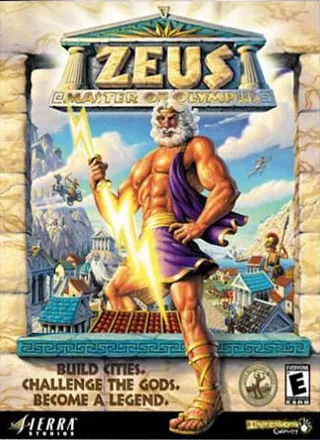
Zeus: Master of Olympus
by Impressions Games·published by Sierra Entertainment
Reader score
7.5/ 10
47 votes
Where to get it
Community
Trailer
Gallery
18About
After Pharaoh, Impressions Games took its city building series into Ancient Greece, land of Zeus, Ares and his dragon, and many other mythological figures.
The most important change to the core of the previous games is how dwellings are built and improve. Instead of allocating single tiles of land the player can choose between building common and elite housing. These only expand inside the allocated plot; common houses cannot evolve into elite houses, which allow the player to build a city block immediately without worrying about newcomers building in the middle of a 2x4 block, rendering the four plots on each side almost useless.
The distribution of goods has also changed. While the production remains the same, goods are now sold at the Agora, a roadside market. Then, the player builds the shops and after they arrive from nearby warehouses and granaries, a peddler roams the streets, selling his goods until he is sold out (roadblocks can be used to control his path, keeping him in the neighborhood).
Finally, religion plays a larger -and more palpable- part than in previous games. In many missions, the player may be facing a monster summoned by a deity (which requires the player to call a hero such as Heracles by building him a nice building with all required commodities) or the Deity himself, which can cause extreme damage to the city (like Ares or Athena) or lure inhabitants away from the city (Aphrodite). To obtain their favor and blessings, the player first must build a gigantic temple and then offer a sacrifice, even if sometimes they help the player from their own kindness. While in previous games their actions were communicated by message boxes, in Zeus they have their own sprites, roaming across the city.
The rest of the game remains unchanged from the core of the series. The player is in charge of developing a plot of land and turn it into a thriving new city. For that, the player must build enough housing spots and provide jobs for the people, either working in production of raw material, manufacturing of goods or services done to the city. These services include philosophers, athletes and actors, who entertain the people and every four years take part in the Olympic Games, which brings fame to the city. Other services include tax collectors, water bearers, healers, watchmen, and superintendents. Each level (excluding sandbox games) have a goal that may range from stockpiling a number of goods, submitting neighboring cities, or acquire enough currency.
Ways to play
Modes
Perspective
Expansions
Included in
Game details
Business Model
Commercial
Supported Systems/Models
x86 (32-bit)
Drivers/APIs Supported
DirectDraw
Media Type
CD-ROM, Download, DVD-ROM
Input Devices Required
Mouse
Input Devices Supported/Optional
Keyboard
Number of Offline Players
1 Player
Save Game Methods
Auto-save, Manual Save
System requirements
Min. CPU Class Required
Intel Pentium
Min. OS Class Required
Windows 95
Min. RAM Required
32 MB
Min. CD-ROM Drive Speed Required
4X (600 KB/s)
Min. Video Memory Required
2 MB
Video Modes Supported
Full screen, Window
Video Resolutions Supported
800×600, 1024×768
Box art
Also known as
Herrscher des Olymp: Zeus — German title
Il Signore dell' Olimpo: Zeus — Italian title
Le Maitre de l'Olympe: Zeus — French title
Master of Olympus: Zeus — UK title
Mestre do Olimpo: Zeus — Brazilian title
Olympens Härskare: Zeus — Swedish title
Señor del Olimpo: Zeus — Spanish title
Zeus: Pan Olimpu — Polish title
Reader ratings
Rate this game
Nobody has rated this yet.
Facts
Developer
Publisher
Released
17 October 2000
Platforms
Age ratings
Standing
Top 99% by visits
Tags
Games like this

You might also like


Game and studio data from IGDB, with release information from Steam, PlayStation, Xbox and Nintendo.