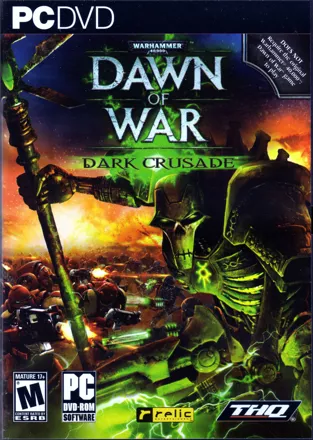
Warhammer 40,000: Dawn of War - Dark Crusade
by Relic Entertainment·published by THQ
Reader score
8.1/ 10
34 votes
How long to beat
only 1 report21h
Rushed
main story only
32h
Normally
story and some extras
43h
Completionist
everything in it
Where to get it
Trailer
Gallery
36Screenshots
Key art
About
The second expansion to the 2004 real-time strategy Dawn of War is set in Game Workshop's Warhammer 40,000 universe and adds two new playable races, the Tau and the Necrons:
- The Tau Empire - a younger race that has recently conquered Kronus, they fight for what they call the Greater Good. They excel at long range combat, however alongside them fight two allied races which are effective in close combat: the Kroot and the Vespid.
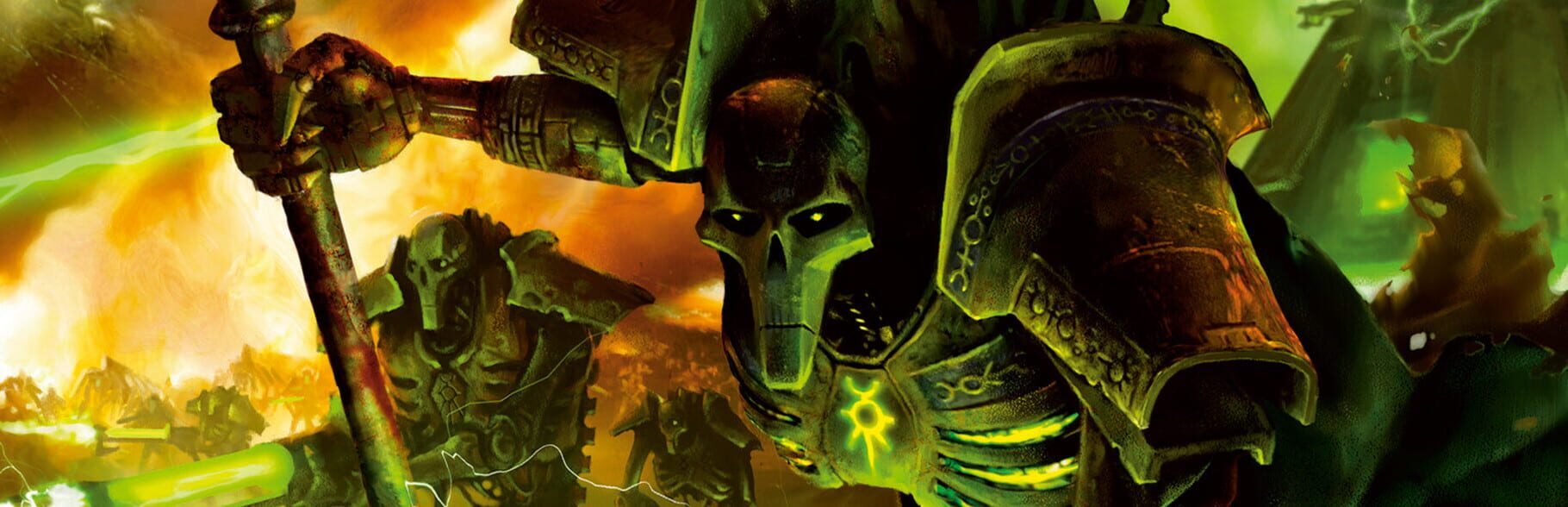
- Necrons - having laid dormant underground for the last 60 million years, the Necrons have awoken at the sound of battle above. Their ultimate goal is to obliterate all living beings so that their master gods can feast on the souls of the slain. This faction is special because they don't rely on requisition to acquire troops or to build structures. Being made of living metal their units are capable of regeneration and can reassemble themselves after death.
Besides that, each of the existing races have received an additional unit: the daemon prince (Chaos Space Marines), harlequin (Eldar), heavy weapons team (Imperial Guard), flash gitz (Orks) and the grey knights (Space Marines). Dark Crusade also features a new campaign mode where you choose one of the five past races, or two new ones and compete with the other six for domination of a planet called Kronus. Each race has its own story and reason for being on Kronus adding motivation for players to play the campaign with each race at least once. Along with the campaign Dark Crusade adds some new maps for skirmish, and online play.
The main campaign introduces a novelty for the franchise--a global map depicting the planet Kronus divided into 25 provinces. Every one of the seven races controls a number of these provinces at the beginning and the gameplay follows mechanics similar to a game of Risk, albeit without any dice rolls. During their turn, the factions can attack a bordering enemy province, move to a friendly region or do nothing. It's also possible for them to reinforce any of the territories already under their control or recruit Honor Guards, but this doesn't waste their turn. The army moves around the global map as a single entity represented by the force commander and it cannot be divided. To defeat a faction you must conquer their stronghold province and the ultimate goal is to crush all enemies. From time to time you will be forced to defend a region against attacks during the opponents' turn. If your army is in a nearby province when this happens then you will start the battle with the force commander and the Honor Guards already present.
Every province held generates planetary requisition at the end of your turn. This can be used to either train available Honor Guards or reinforce a province of your choice. Honor Guards are unlocked as a bonus when conquering a specific region. By reinforcing a province during your turn you make sure that it already has the trained unit or the selected building at the very start of a defensive battle. Another innovation for the series is the force commander's wargear. It is a sort of achievement system that rewards additional pieces to the commander's suit for reaching different milestones, such as conquering your first province or getting 2000 kills. The pieces you choose will add specific bonuses or abilities for the force commander on the battlefield.
After attacking a province or when defending one the game switches to the usual Dawn of War battle map where you control different units and structures directly. The gameplay here is identical to the original. The main focus is on tactical combat, base-building, capturing strategic points and researching. Every strategic point under your control, along with your HQ, relics and critical points generate requisition, which is the main resource in the game, allowing you to build new structures and train more units. Another type of resource is power, produced using generators. It's used to create or upgrade units and buildings that rely heavily on technology. The order in which you research the tech tree and construct the necessary structures can help you decide on a strategy for the combat part of the game. Attacking is done by simply clicking on an enemy, the challenge lies in choosing the right units to exploit the adversary's weaknesses. Infantry squads have health bars for every member, so it's possible to replace fallen soldiers during the battle, thus saving the squad from total annihilation. Vehicles are organized as single units and are destroyed once their health reaches zero, however they can be repaired during combat by the faction's builder unit. Some combat units and structures, such as listening posts have different upgrades available that increase their firepower. For example the space marines can receive flamethrowers and grenade launchers in addition to their regular weapons. Upgrading the HQ unlocks new technology and units.
Unlike the original and Winter Assault, most of the battle maps in this campaign are simple skirmish maps, as they have no story element except an introduction or an entry about the province in the archive, and victory is decided by completing the main objective, usually annihilating the enemy or another one of the Skirmish mode victory conditions. The factions' stronghold provinces are the exceptions, since conquering them involves multiple main and secondary objectives driven by a central narrative much like all the campaign missions in the original Dawn of War.
Dark Crusade is a standalone expansion meaning that it does not require the original Dawn of War, or its first expansion Winter Assault to play. However, the player can only access non-Dark Crusade factions in multiplayer if their respective games they were introduced in are installed on the same system (retail versions) or owned on the same account (digital versions).
Ways to play
Modes
Perspective
Expansion for
Included in
Languages
5 languages, with audio, subtitles and interface
| Language | audio | subtitles | interface |
|---|---|---|---|
| English | — | — | |
| French | — | — | |
| German | — | — | |
| Italian | — | — | |
| Spanish (Spain) | — | — |
Game details
Business Model
Commercial
Supported Systems/Models
x86 (32-bit)
Drivers/APIs Supported
Direct3D, Hardware TNL, OpenGL
Media Type
Download, DVD-ROM
Input Devices Supported/Optional
Keyboard, Mouse
Additional Hardware Required
3D Accelerator
Multiplayer Options
Internet, LAN
Multiplayer Game Modes
Free-for-all / One-on-one (VS), Team
Number of Offline Players
1 Player
Number of Online Players
2-8 Players
Steam
Cloud
System requirements
Min. CPU Class Required
Intel Pentium 4
Min. OS Class Required
Windows 2000
Min. RAM Required
512 MB
Min. DirectX Version Required
DirectX 9.0c
Min. DVD-ROM Drive Speed Required
4X (5.28 MB/s)
Min. Video Memory Required
64 MB
Video Modes Supported
Full screen
Video Resolutions Supported
1024×768, 1280×1024
Box art
Also known as
DoW:DC — Common abbreviation
Reader ratings
Rate this game
Nobody has rated this yet.
Facts
Developer
Publisher
Released
9 October 2006
Platforms
Age ratings
Standing
Top 1% by 24hr peak players