Transport Tycoon
by Chris Sawyer Productions·published by MicroProse Software, Inc.
Reader score
8.0/ 10
73 votes
Where to get it
Community
Gallery
19About
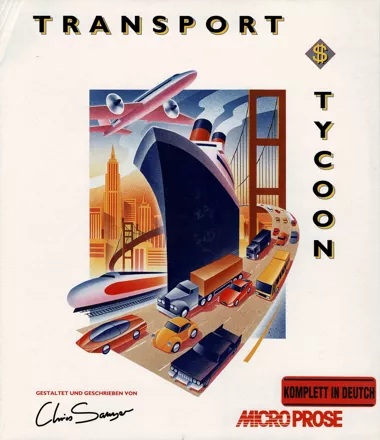
In Transport Tycoon, the player is in charge of a transport company starting in 1930 in the midst of The Great Depression, and the aim is to build up an empire of trains, ships, lorries, planes and helicopters, with technological evolution gradually taking place and allowing for better vehicles to be used. The game can be played alone, or with a number of computer-controlled rivals.
At the beginning of the game, a large terrain is generated. It is shown in isometric projection and includes hills, rivers, lakes, bridges, industrial facilities and a lot of small towns. It is up to the player to decide how to start building a transport empire.
All transport connections involve linking towns and/or factories, constructing vehicle depots and purchasing vehicles. For example, a common starting move includes connecting two towns with a road, building a vehicle depot somewhere next to the road, and setting up bus stops in both towns. Then, a bus needs to be purchased, its schedule set, and ordered to start. As it goes between both bus stops, taking passengers and unloading them, it earns its owner money. Train networks are built similarly, but require individual locomotives and appropriate wagon types to be assigned to each train. Most businesses offer certain types of cargo and are ready to pay for transporting other cargo to them; for example, a steel mill has a lot of steel to fill entire wagons, and will gladly accept iron ore any is available.
Landscaping tools are also available, best used for clearing terrain for new roads or tracks, or for creating canals for ships to pass through. Some buildings like airports require large sections of flat land.
Clicking on any vehicle brings up a small window where a live feed of what the vehicle is doing can be observed and its status is shown. If anything important happens during the game (such as a particular station accepting its first vehicle), it is shown as a newspaper headline at the bottom of the screen.
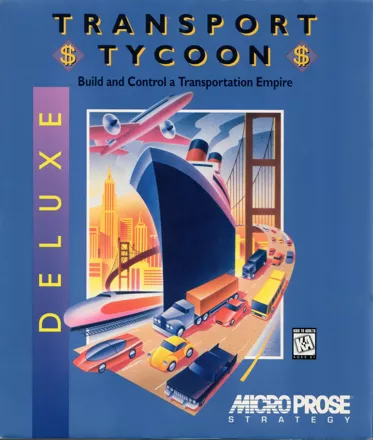
Various versions exist building upon the DOS original, with the most notably different being the PlayStation port, which in addition to the isometric graphics includes a 3D view of the world map taking advantage of the PlayStation’s graphics hardware. The game was followed up with the release of the World Editor and later re-released in enhanced form as Transport Tycoon Deluxe.
Ways to play
Modes
Perspective
Expanded into
Remastered as
Game details
Business Model
Commercial
Media Type
3.5" Floppy Disk, CD-ROM
Input Devices Required
Mouse
Input Devices Supported/Optional
Keyboard
Multiplayer Options
Null-modem cable
Multiplayer Game Modes
Free-for-all / One-on-one (VS)
Number of Offline Players
1 Player
Number of Online Players
2 Players
Save Game Methods
Manual Save
System requirements
Min. CPU Class Required
Intel i386
Min. OS Class Required
PC/MS-DOS 5.0
Min. RAM Required
4 MB
Min. MSCDEX Required
2.1
Min. CD-ROM Drive Speed Required
2X (300 KB/s)
Video Modes Supported
SuperVGA, VESA
Sound Devices Supported
Adlib, General MIDI, Gravis Ultrasound / ACE, Pro Audio Spectrum, Roland MT-32 (and LAPC-I), Roland Sound Canvas, Sound Blaster, Sound Blaster 16, Sound Blaster AWE32, Sound Blaster Pro
Box art
Also known as
Chris Sawyer's Transport Game — Working title (used in <moby game="Frontier Elite 2">Frontier: Elite 2</moby>)
I.T.S. — Working title
Interactive Transport Simulation — Working title
Transport Tycoon 3D — Japanese PlayStation version, Japanese title
Transportation Tycoon — Working title
Reader ratings
Rate this game
Nobody has rated this yet.
Facts
Developer
Publisher
Released
1994
Series
Transport TycoonPlatforms
Age ratings
Standing
Top 45% by visits