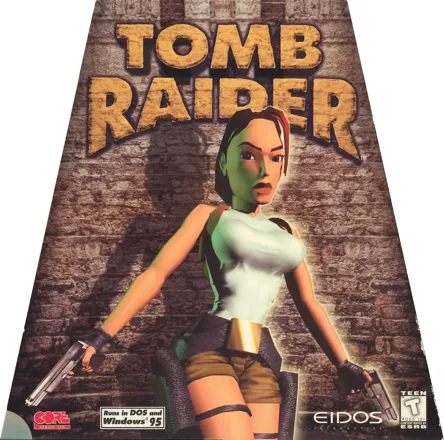
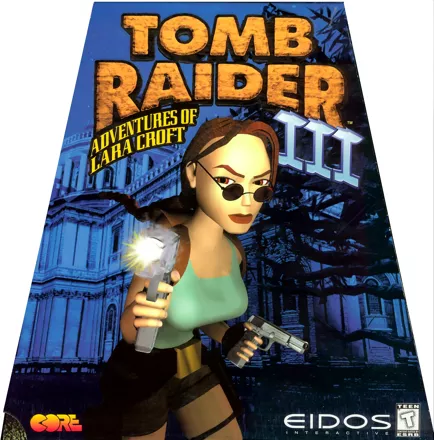
Tomb Raider III: Adventures of Lara Croft
by Core Design·published by Eidos Interactive, Aspyr Media
Reader score
7.5/ 10
131 votes
How long to beat
only 2 reports13h
Rushed
main story only
33h
Normally
story and some extras
48h
Completionist
everything in it
Where to get it
Trailer
Gallery
25Screenshots
Key art
About
The intrepid archaeologist Lara Croft ventures to India, searching for a legendary stone that once belonged to the tribe of Infada. Shortly after recovering the precious stone, she encounters a Dr. Willard, the head of an organization known as RX Tech. Willard is interested in an ancient Polynesian city built by people of a now defunct civilization, which worshipped a mysterious meteorite that hit the Earth millions of years ago. Willard tells Lara that the Infada Stone is in fact one of the four artifacts the ancient Polynesians fashioned from the material contained in the meteorite's core. Willard suggests Lara should look for the other three, scattered and hidden in various regions of the planet. It looks like another dangerous adventure awaits the fearless "tomb raider"!
Tomb Raider III: Adventures of Lara Croft is an action game with platforming and puzzle-solving elements. The gameplay system is similar to the one implemented in the previous game. Lara's abilities include running, jumping, climbing, swimming, rolling, crouching, crawling, sprinting, and swinging on bars and vines. A few new types of hazards have been added in this installment, including cold water in which Lara can swim for a limited amount of time, dangerous underwater creatures (such as piranhas), and the treacherous quicksand, which will swallow the heroine if the player isn't careful and fast enough to prevent her from falling into it.
As in the previous game, Lara uses pistols, shotguns, harpoon guns, uzis, and grenade launchers to defend herself. New weapons include the Desert Eagle, MP5 sub-machine-gun, and rocket launcher. A few levels are designed in such a way that sneaking becomes the preferable solution, rather than directly engaging the enemies in combat. Unlike the previous games, the player can choose to tackle the levels in any order following the introductory Indian scenario.
The player can save the game at any time in both the PC and the PlayStation versions; however, in the latter the amount of times the player can save the game depends on the amount of special crystals collected by Lara during her journey.
Ways to play
Modes
Perspective
Editions
Expansions
Included in
Remastered as

Languages
6 languages, with audio, subtitles and interface
| Language | audio | subtitles | interface |
|---|---|---|---|
| English | — | ||
| French | — | ||
| German | — | ||
| Italian | — | ||
| Japanese | — | ||
| Spanish (Spain) | — |
Game details
Business Model
Commercial
Supported Systems/Models
x86 (32-bit)
Media Type
CD-ROM, Download, DVD-ROM
Input Devices Supported/Optional
Gamepad, Keyboard
Number of Offline Players
1 Player
Save Game Methods
Internal Storage
System requirements
Min. CPU Class Required
Intel Pentium
Min. OS Class Required
Windows 95
Min. RAM Required
16 MB
Min. DirectX Version Required
DirectX 6
Min. CD-ROM Drive Speed Required
4X (600 KB/s)
Video Modes Supported
Full screen
Video Resolutions Supported
640×480, 800×600
Sound Devices Supported
DirectX Compatible Sound Card
Box art
Also known as
Tomb Raider III: Les aventures de Lara Croft — French title
Tomb Raider III: Novas Aventuras de Lara Croft — Brazilian title
Reader ratings
Rate this game
Nobody has rated this yet.
Facts
Developer
Publisher
Ported by
Released
1998
Series
Tomb RaiderPlatforms
Age ratings
Standing
Top 12% by 24hr peak players