

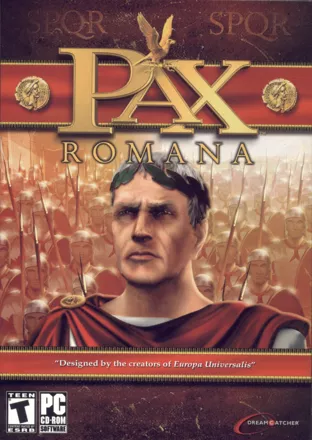
Pax Romana
by Galiléa·published by DreamCatcher Interactive
Reader score
5.2/ 10
8 votes
Where to get it
Gallery
26Screenshots
Key art
About
Pax Romana is a real-time strategy game in the tradition of Europa Universalis. The setting: the ancient Mediterranean world. The objective: control the destiny of the Rome. There are two gameplay modes: strategic and political.
In the strategic mode, the player controls Rome with the goal of securing the Republic and expanding its borders while also keeping the citizens happy. The map can be viewed through four different filters: military, economic, diplomatic, and administrative. Military view allows the player to manage armies and navies and appoint leaders of varying skills and abilities. In the economic view, the focus is on trade goods; the player must build trade routes (imports and exports) for each territory. Trade routes vary in value, cost to establish, and likelihood of being broken by war or other events. Diplomatic view allows the conduct of foreign relations; the player can raise or lower relations with other states (both major and minor) through gift-giving, public approval/disapproval, support of rebels, and other means. Once relations deteriorate, Rome has the option of declaring war—a necessity before making any aggressive military moves. Administrative view has the player building military units and roads, clearing land for economic development, and setting the priorities of the local governors.
In political mode, the player controls one of six historical factions, each with its own agenda. Success in this mode depends not only on fulfilling the overall goals of the strategic mode, but also on achieving the goals of the individual faction. This requires getting your faction members elected to the various offices (including censors, tribunes, governors, consuls, and proconsuls) and implementing policies through the Senate. Elections occur on a yearly basis, with the rest of the time being spent on politicking at the various locations of the Forum (baths, basilica, tavern, etc.).
Historical scenarios range from the Punic Wars to the rise of Caesar. A scenario editor is also included, giving the player the chance to alter scenarios and build new completely new ones. Of course, the ultimate goal is always the same: expand your power and establish the Pax Romana.
Ways to play
Modes
Perspective
Languages
1 languages, with audio, subtitles and interface
| Language | audio | subtitles | interface |
|---|---|---|---|
| English | — |
Game details
Business Model
Commercial
Media Type
CD-ROM
Input Devices Supported/Optional
Keyboard, Mouse
Multiplayer Options
Internet, LAN
Number of Offline Players
1 Player
System requirements
Min. CPU Class Required
Intel Pentium III
Min. OS Class Required
Windows 98
Min. RAM Required
128 MB
Min. DirectX Version Required
DirectX 8.1
Min. CD-ROM Drive Speed Required
4X (600 KB/s)
Box art
Also known as
Luoma de Heping — Chinese Title
Reader ratings
Rate this game
Nobody has rated this yet.
Facts
Developer
Publisher
Released
6 November 2003
Platforms
Age ratings
Tags
Games like this


You might also like

Game and studio data from IGDB, with release information from Steam, PlayStation, Xbox and Nintendo.