
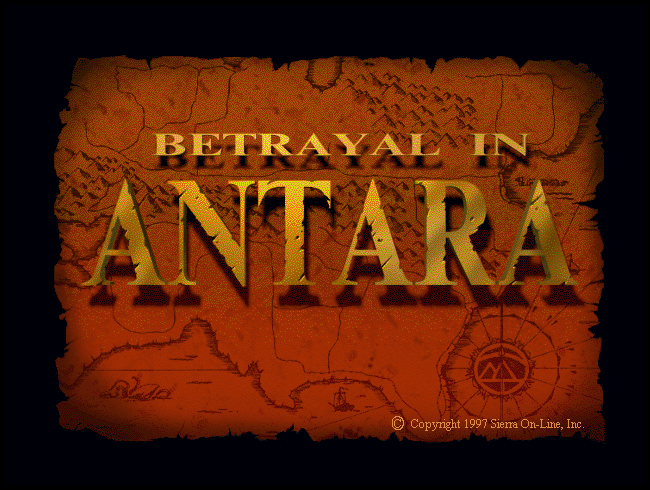
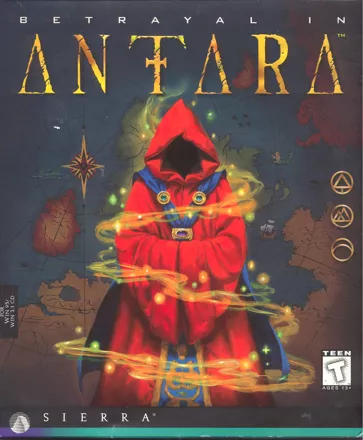
Betrayal in Antara
by Sierra Entertainment·published by Sierra Entertainment
Reader score
6.7/ 10
25 votes
Where to get it
Gallery
44About
Betrayal in Antara uses an updated version of the game engine from Betrayal at Krondor. However, it does not continue Raymond E. Feist's Riftwar saga, but instead starts a new tale set in a different fantasy world, known as Ramar.
The story begins with William Escobar, the son of the governor of Pianda, sailing home to meet his fiancee. The ship is attacked by pirates, and William escapes in a life boat with a mortally wounded traveler. Before he dies, the stranger gives William a medallion, warning him of a conspiracy against the Empire. William meets a young magician named Aren, who has just discovered devastating powers within himself, and the two decide to meet William's father and ask for his advice concerning the unsettling information.
The game plays very similarly to Betrayal at Krondor. The player navigates a party of three characters through the 3D world - this time with an optional full screen view. Enemy encounters occur at set positions on the overworld or within the few dungeons. An encounter triggers a separate battle screen, on which player-controlled party and the enemies engage in tactical turn-based combat. It is possible to sneak on enemies for a surprise attack if the character's corresponding skill is high enough. Unlike the predecessor, most towns can be physically explored, though a few are still displayed as a map with icons representing locations. Indoor environments and characters, however, are presented as hand-drawn images.
Like in Betrayal at Krondor, characters join and leave the party as dictated by the plot. Aren is the only character who can cast spells, while others act like fighters or rangers. Magic elements can be researched and mixed to create spells, and include a wide array of protective and offensive magic. The skill system is very similar to that of the previous game: skills are improved by repeatedly using them and marking them in the skill menu for faster learning. Elements like a day and night cycle, weapon and armor repairing, navigation on world map, the necessity to eat and sleep regularly, etc. are also brought over from the earlier Dynamix game. Although the game is somewhat more linear, there is still a large amount of side quests taken from NPCs populating the game's many towns.
Ways to play
Modes
Perspective
Included in
Languages
1 languages, with audio, subtitles and interface
| Language | audio | subtitles | interface |
|---|---|---|---|
| English | — |
Game details
Business Model
Commercial
Media Type
CD-ROM
Input Devices Supported/Optional
Keyboard, Mouse
Number of Offline Players
1 Player
System requirements
Min. CPU Class Required
Intel i486 DX2
Min. OS Class Required
Windows 95
Min. RAM Required
16 MB
Min. CD-ROM Drive Speed Required
4X (600 KB/s)
Video Modes Supported
Full screen
Video Resolutions Supported
640×480
Box art
Also known as
Traição em Antara — Brazilian title
Reader ratings
Rate this game
Nobody has rated this yet.
Facts
Developer
Publisher
Released
1997
Platforms
Age ratings
Standing
Top 54% by want to play
Tags
Games like this


You might also like



Game and studio data from IGDB, with release information from Steam, PlayStation, Xbox and Nintendo.